
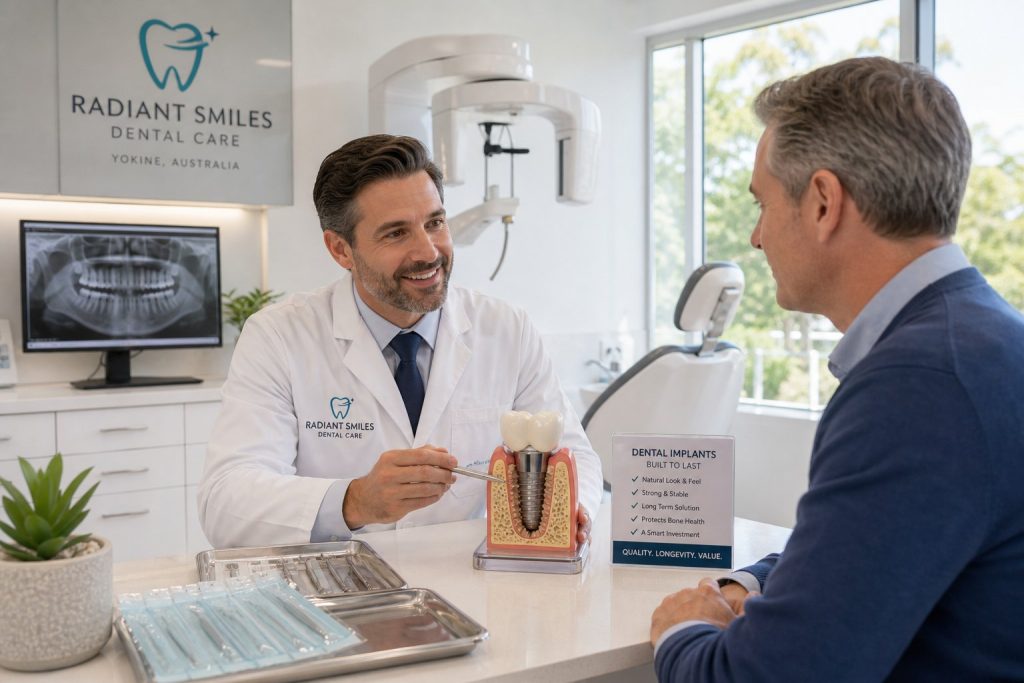
Dental implants have become a popular solution for replacing missing teeth, offering benefits that extend well beyond aesthetics. Unlike traditional dentures or bridges, they provide a stable, natural-feeling option built to last for many years. One thing patients often weigh first is the dental implants cost, since the upfront price tends to be higher than other replacements, though the durability and reduced upkeep usually make implants the smarter choice over time.
This article explores how dental implants work, compares them to other options, and examines why they represent a wise long-term investment for patients, especially those seeking care at Radiant Smiles Dental Care in Yokine, WA.
Key Takeaways
- Dental implants provide a stable, natural-feeling tooth replacement that can last 20 years or more, making them a valuable long-term investment.
- Unlike dentures and bridges, dental implants prevent jawbone loss by stimulating the bone and do not require altering adjacent healthy teeth.
- Although dental implants have higher initial costs, their durability and reduced need for maintenance make them more cost-effective over time.
- Proper care, including daily cleaning and regular dental check-ups, is essential to ensure the longevity and success of dental implants.
- Dental implants significantly improve quality of life by restoring chewing efficiency, enhancing speech clarity, and boosting confidence with a natural appearance.
- Choosing experienced dentists, such as those at Radiant Smiles Dental Care in Yokine, and considering personal health factors are crucial before investing in dental implants.
Understanding Dental Implants: What They Are and How They Work
A dental implant consists of a small titanium or zirconia post that is surgically placed into the jawbone to serve as an artificial tooth root. This post integrates with the bone through a natural process called osseointegration, forming a strong and stable foundation. Once the implant has securely bonded with the bone, a connecting piece called an abutment is attached, which supports a crown, bridge, or denture. The final restoration functions and looks much like a natural tooth. When placed and cared for properly, dental implants boast success rates exceeding 95%, making them a reliable choice for patients in Yokine and beyond.
Comparing Dental Implants to Other Tooth Replacement Options
Compared to dentures, dental implants offer far greater stability. Dentures rest on the gums and may slip during eating or speaking, requiring replacement or relining every 5 to 10 years. Importantly, they do not stimulate bone, which can lead to continued jawbone loss and changes in facial structure over time. Bridges, on the other hand, typically need the adjacent healthy teeth to be ground down, which may weaken them and increase the risk of decay. Like dentures, bridges sit on top of the gums and do not prevent bone loss at the site of the missing tooth. In contrast, implants stand independently and directly support the restoration, preventing bone deterioration and preserving facial contours. They are often designed to last 20 years or more, with many patients enjoying them for life, especially when receiving expert care such as at Radiant Smiles Dental Care in Yokine.
The Financial Perspective: Initial Costs Versus Long-Term Value
While dental implants typically come with a higher upfront cost, often ranging between US$1,500 and US$6,000 per tooth depending on case complexity and location, their long-term value often outweighs this initial investment. Dentures and bridges may appear more affordable initially but usually require periodic replacement, relining, and associated maintenance. These ongoing costs, along with potential treatments for bone loss or damage to adjacent teeth, can accumulate over time. Implants, designed to be long-lasting or lifelong, reduce the need for such interventions, proving more cost-effective in the long run. Financing options, including insurance coverage where applicable, payment plans, and treatment at dental schools or nonprofit clinics, can help make implants more accessible for patients in Yokine and surrounding areas.
Health Advantages of Choosing Dental Implants
Dental implants provide several notable health benefits. Unlike dentures or bridges, implants help preserve the jawbone by stimulating it much like natural tooth roots do, which can prevent or significantly slow bone loss. This preservation supports the overall structure of the mouth and face. Also, because implants don’t rely on neighbouring teeth for support, there is no need to alter healthy teeth, reducing the risk of damage and decay. Maintaining bone density and tooth position also promotes stability in the bite, lowering the chances of further tooth loss or misalignment. Also, implants eliminate issues like soft-tissue irritation and sore spots commonly caused by ill-fitting dentures, enhancing overall oral comfort.
Enhancing Quality of Life with Dental Implants
Beyond the health advantages, dental implants greatly improve quality of life. They restore chewing efficiency to approximately 70% of natural biting force, allowing patients to enjoy a varied diet without restriction. Because implants are securely fixed, they improve speech clarity compared with loose or ill-fitting dentures that can slip or click. Implants also offer enhanced comfort as they do not move or cause irritation. With their natural appearance, these restorations boost self-confidence and overall satisfaction with one’s smile. Unlike dentures, implants do not need to be removed daily, simplifying oral hygiene routines and adding convenience to everyday life. Patients of Radiant Smiles Dental Care in Yokine often highlight these benefits after treatment.
Maintenance and Longevity: Caring for Your Dental Implants
Proper care is essential to ensure dental implants last for 15 to 25 years or longer, with many patients experiencing lifelong service. Maintaining implants involves twice-daily brushing, along with daily cleaning between teeth and implants using floss or interdental brushes designed for implants. Regular dental check-ups, recommended every six months, allow professionals to monitor implant health through clinical exams and X-rays, as well as to perform thorough cleanings. Patients are also advised to avoid tobacco, which significantly increases the risk of peri-implantitis, a condition that can lead to implant failure. Likewise, habits such as chewing hard objects or using teeth improperly should be avoided to prevent damage. Radiant Smiles Dental Care provides thorough guidance and continuing support to help patients in Yokine maintain their implants successfully.
Factors to Consider Before Investing in Dental Implants
Several key factors should be evaluated before deciding on dental implants. Good general health and healthy gums are prerequisites, as is sufficient jawbone density to support the implant: when bone volume is lacking, procedures like bone grafting may be necessary. Smoking can reduce the success rate, so patients are encouraged to quit before and after the surgery. The number and location of missing teeth influence the treatment plan and overall cost. Some patients may require additional procedures such as tooth extractions or sinus lifts, which can extend treatment time and expenses. The expertise of the implant dentist is crucial for ensuring success and long-term value, seeking providers with proper credentials and experience, like those at Radiant Smiles Dental Care in Yokine, can significantly impact outcomes. Finally, patients should assess financial considerations, exploring insurance coverage, financing programs, or affordable care options to make the investment manageable.
About Radiant Smiles Dental Care
Business: Radiant Smiles Dental Care
Spokesperson: Dr Anand Ponnusamy
Position: Principal Dentist
Phone: (08) 9440 3654
Email: [email protected]
Location: Shop 6/201 Flinders Street, Yokine WA 6060
Website: https://radiantsmiles.com.au/
Google Maps Link: https://maps.app.goo.gl/soGsWGFiqjWEKR1q7
Frequently Asked Questions about Dental Implants
What is a dental implant and how does it work?
A dental implant is a titanium or zirconia post surgically inserted into the jawbone, acting as an artificial tooth root. It integrates with the bone through osseointegration, providing a stable foundation to support crowns, bridges, or dentures that look and function like natural teeth.
How do dental implants compare to dentures and bridges?
Dental implants offer greater stability than dentures, which may slip and require replacement every 5–10 years. Unlike bridges, implants do not need adjacent teeth to be altered and help prevent bone loss, preserving facial structure and offering a longer-lasting solution often exceeding 20 years.
Why are dental implants considered a good long-term investment despite higher initial costs?
Although dental implants have higher upfront costs, they tend to last much longer and reduce the need for replacements or additional treatments associated with dentures and bridges. This longevity and reduced maintenance make implants more cost-effective over time.
What health benefits do dental implants provide?
Dental implants preserve jawbone density by stimulating it like natural tooth roots, protect neighbouring teeth from damage, maintain oral stability, and reduce soft-tissue irritation common with dentures. These benefits promote better overall oral health.
How should I care for dental implants to ensure they last?
Proper care includes twice-daily brushing, daily interdental cleaning, and regular dental check-ups every six months. Avoiding tobacco and harmful habits like chewing hard objects also helps prevent complications and ensures implants can last 15 to 25 years or longer.
Who is an ideal candidate for dental implants?
Ideal candidates have good general health, healthy gums, and sufficient jawbone density. Smokers are advised to quit before and after surgery. Additional procedures like bone grafting may be needed if bone is insufficient, and the expertise of the implant dentist greatly influences success and longevity.